
Idaho Falls CRC Release Paths
Idaho Falls Community Reentry Center is an IDOC facility for minimum-custody men nearing release. Its community setting does not make placement a completed release. A resident can remain assigned there until release to parole, another approved form of supervision, full-term sentence satisfaction, transfer to another IDOC location, or another documented outcome.
The decisive evidence comes after placement. An IDOC record that changes from “In custody” to “In community” can show the move into state supervision. Released to Supervision records the most recent placement under supervision by a court or the Commission. Sentence Satisfaction Date is the active sentence endpoint. A Commission Notice of Action Taken may identify a tentative parole date, but required programming and an approved parole plan must still be complete.
Confirm Idaho Falls CRC Release
The correct locator is the IDOC Resident/Client Search. It covers incarceration, probation, parole, and satisfied former state sentences. IDOC reports daily updates but warns that status, location, and dates may not be current. A same-day conflict should be confirmed with the named office or a state record request.
- Search by last name and optional first name, or use the IDOC number.
- Match the result by IDOC number, age, sentencing county, and case number rather than name alone.
- Open the record and distinguish overall “In custody” from “In community.”
- Read the sentence status and exact labels, including Released to Supervision and Sentence Satisfaction Date.
- If parole applies, compare the later status with the Commission action and request the release paper when exact proof matters.
A Jefferson County sentencing county does not mean the person remained in the county jail. Likewise, a District 7 supervision office does not prove the county of incarceration. The main Jefferson County release search separates county, state, and federal paths.
Idaho Falls CRC Records
The facility can answer operational questions, while IDOC's central record system supplies the public status and formal record path. Ask IDOC for a sentence-calculation report, release-to-supervision document, full-term satisfaction or discharge record, or another named release paper. A focused request avoids confusion between a tentative date and an actual event.
Idaho Falls Community Reentry Center3955 Bombardier Ave.
Idaho Falls, ID 83402
208-525-7143Idaho Department of Correction
1299 N. Orchard St., Suite 110
Boise, ID 83706
208-658-2000
IDOC records portal
If the issue involves a Commission decision, first check its published Notice of Action Taken. Summary minutes and other available Commission records use the Commission's public-information route. State records, not the Jefferson County Sheriff, control release from this IDOC placement.
Idaho Falls CRC Custody
The official facility page identifies a regional community reentry center operated within the Idaho correctional system. It houses up to 112 minimum-custody men who are nearing release. The facility is outside Jefferson County, but it is relevant when a state-sentenced person from Jefferson County is assigned there.
Minimum custody describes security and placement, not sentence completion. A person can work toward community transition while still being confined under IDOC authority. That is why the facility address alone cannot prove release.
The official IDOC source also provides useful visual context for the custody setting.
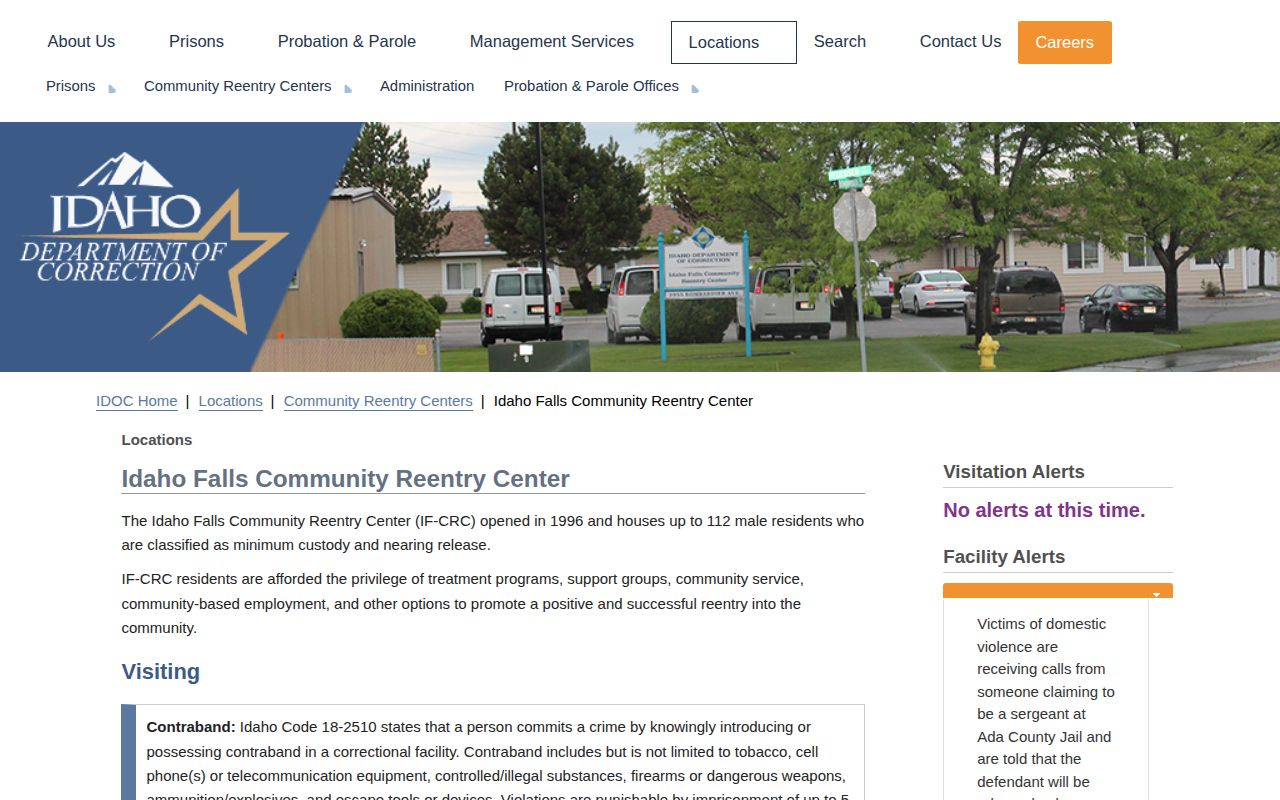
The facility description supports the central distinction between reentry placement and documented release.
Idaho Falls CRC Status Fields
IDOC labels must retain their exact meaning. The public interface does not use a field literally called “Projected Release Date.” Replacing the state labels with a generic phrase can turn an eligibility date or hearing date into a false promise.
| IDOC field | Meaning |
|---|---|
| In custody | The person remains held at an IDOC location, including a reentry center. |
| In community | The person may be on probation or parole through a supervising district. |
| Released to Supervision | The most recent placement under supervision by a court or Commission. |
| Sentence Satisfaction Date | The endpoint of the active sentence. |
| Parole Eligibility Date | The earliest chance for discretionary parole consideration. |
| Next Parole Hearing Date | A scheduled decision event, not a release. |
A satisfied former IDOC resident can remain name-searchable while convictions no longer display. That persistence helps confirm a past state-custody connection even after a county roster would have dropped the person.
Is Idaho Falls CRC Release?
No. Idaho Falls Community Reentry Center is still a custody placement. The less restrictive setting and reentry work can make the status look like community release, but IDOC retains custody until the later documented change. This is the distinctive local trap for Jefferson County searches.
Look for a later overall “In community” status and Released to Supervision date. If parole was involved, pair them with the Commission's action notice. A tentative parole date remains forward-looking. For full discharge, use sentence satisfaction or the official discharge record.
The Commission calls the final parole discharge document a Gold Seal. A parolee has already left prison but remains under supervision until that later discharge. Released to parole and discharged from parole must therefore be recorded as separate events.
Idaho Falls CRC Release Timing
Parole Eligibility Date is not an entitlement. The Commission may grant, deny, defer, rescind, or later revoke parole. Even after a grant, programming, an approved parole plan, paperwork, and transportation can affect the actual date. Nobody should be described as released merely because a tentative date has arrived.
Idaho's fixed felony term is ordinarily served before parole consideration. The state does not use a generic modern 85-percent formula. Ordinary good-time deductions cited in older law concern pre-July 1986 offenses, while modern meritorious reduction is narrow and extraordinary.
When the public fields conflict, use Commission decision notices, the later IDOC status, and the release document. Each source answers a different stage of the process.
Idaho Falls CRC Release Proof
One document rarely proves every stage. A Commission notice can show a grant and tentative parole date. The later IDOC status can show that the person moved from custody into the community. Released to Supervision supplies a dated supervision placement, while the formal release paper gives the durable agency evidence. Sentence Satisfaction Date addresses the sentence endpoint rather than the door-release time.
Court records add the sentencing and probation context. They do not replace IDOC's physical-custody record for a person housed at the reentry center. Idaho VINE may provide a prompt alert, but a transfer alert can reflect movement within custody and must not be treated as community release.
When exact timing matters, name each desired record in the GovQA request. Ask for the release-to-supervision documentation, sentence-calculation report, full-term satisfaction record, or discharge paper as applicable. If a public-search field is stale or incorrect, include the IDOC number, the displayed field, and the reason for seeking review. This focused approach gives the records officer a clear correction or production task without guessing at unpublished database labels.