
IDOC Jefferson County Release Scope
No IDOC prison was identified inside Jefferson County. State-sentenced people can be placed at any institution or community-custody setting that IDOC assigns. The statewide Resident/Client Search is therefore the correct public locator for state incarceration, felony probation, parole, and satisfied former state sentences.
A Jefferson County booking and an IDOC record have different life cycles. The Sheriff documents the local jail endpoint. IDOC begins to matter when state jurisdiction follows, or when the person is under state probation or parole. A Jefferson County sentencing county does not prove that the person remains in the county. District 7 supervision also does not prove where the person was incarcerated.
IDOC says names of people who served time and satisfied their sentences remain searchable, although their convictions stop displaying. That makes the state tool useful after a current county custody view would no longer help.
Search IDOC Jefferson County Records
Search with last name and optional first name, or with an IDOC number. The public form accepts at least two letters for a partial surname and at least three digits for a partial IDOC number. Name alone is not enough for a safe match. Compare age, IDOC number, sentencing county, and case number.
- Open the IDOC Resident/Client Search and enter a surname or IDOC number.
- Review possible matches and compare stable identifiers and case context.
- Open the detail record and read the overall status before the sentence table.
- Check each sentence's status, supervision date, satisfaction date, and parole fields.
- If a recent event conflicts with the page, contact the named office or request the exact state record.
IDOC states that the search updates daily but may not show the most current status, location, or scheduled termination date. A same-day conflict should lead to verification, not a guess. The full county-to-state path is also covered on the Jefferson County released inmates page.
Note: Do not use IDOC to declare release from a county-only booking that never entered state correctional jurisdiction.
IDOC Release Status Fields
The public IDOC detail record uses exact labels. They should not be renamed to fit a generic release-date model. Overall status and sentence-level status answer different questions, and a person may have more than one sentence row.
| IDOC field | Meaning for release research |
|---|---|
| In custody | The overall record shows current state custody and may list a location. |
| In community | The person may be on probation or parole under state supervision. |
| Termer, Probation, or Parole | The sentence-level status identifies the role of that sentence. |
| Released to Supervision | The most recent placement under supervision by a court or the Commission. |
| Sentence Satisfaction Date | The endpoint of the active sentence, distinct from release to parole. |
| Parole Eligibility Date | The earliest opportunity for discretionary parole consideration. |
| Next Parole Hearing Date | A scheduled decision event, not an actual release. |
The search can also show a community supervision district, office address, officer, and phone. Those fields help verify which IDOC office holds the current public supervision record. They do not establish the exact moment a county jail booking ended.
IDOC Jefferson County Search Screen
The official IDOC search page provides the statewide entry point for Jefferson County state-custody and supervision checks.
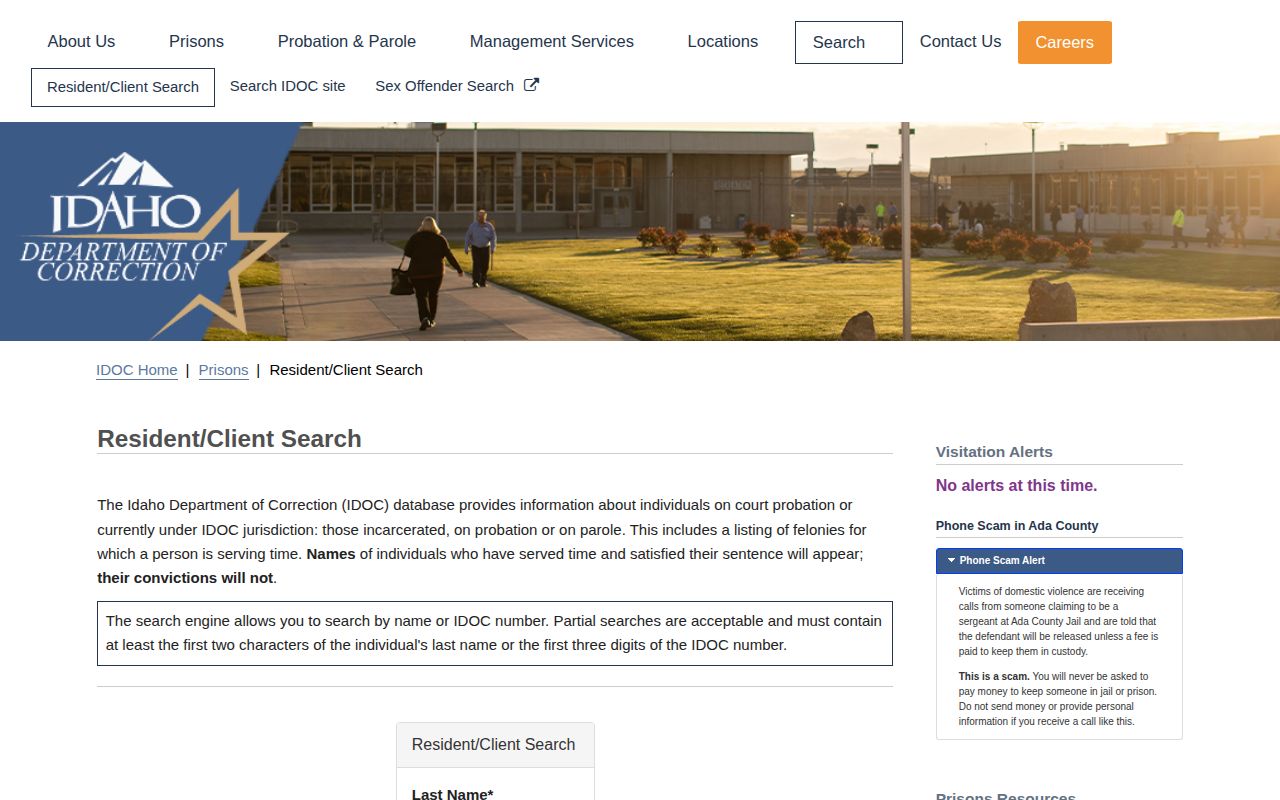
The interface is a state record system. It is not a Jefferson County Jail roster, and its detail pages reviewed for this project did not display a resident photograph.
An identification image may be requested through IDOC GovQA, but IDOC decides whether one exists and is public after applying exemptions and redaction. No photo should be promised from the public Resident/Client Search.
Confirm IDOC State Release
A state-prison release is best confirmed by joining several observations. A Commission action or full-term endpoint supplies the legal path. A later overall “In community” status indicates community placement. Released to Supervision gives the related state field date. For final sentence completion, use Sentence Satisfaction Date or the official discharge record.
Parole and discharge are not the same event. A person released to parole has left prison but remains under sentence supervision. The Commission calls its final parole discharge document a Gold Seal. It routes through the last supervision district and may take up to a month to reach the former parolee.
Does “In community” mean the sentence ended? No. It can identify active probation or parole. Inspect the sentence-level status and satisfaction field before describing a final discharge.
IDOC Parole Decision Records
The Idaho Commission of Pardons and Parole, not the search interface, publishes tentative parole dates in Notices of Action Taken. Its decision archive can show a grant, denial, deferral, pass to full term, rescission, or revocation action. The Commission warns that a tentative date is not final.
Programming, an approved parole plan, paperwork, and other conditions must be complete before actual release. No one releases before the published tentative date, but the real event can occur later. Return to IDOC after the date and check for “In community” and Released to Supervision. When exact evidence matters, request the release document.
The Commission decision archive supplies the action record, while the IDOC detail supplies the later correctional status. Together they prevent a planned event from being mislabeled as completed.
Note: A hearing appearance proves only that review was scheduled; the posted action and later correctional status show what followed.
Request IDOC Release Records
Use the IDOC GovQA records portal when the public status is unclear, an entry appears wrong, or a specific release paper is needed. A narrow request helps the agency identify the record without confusing eligibility, supervision, and discharge.
- Give the person's name, IDOC number if known, and the relevant sentence or case context.
- Name the sentence-calculation report, release-to-supervision document, sentence-satisfaction record, or discharge record sought.
- Ask for the public portions and accept reasonable redaction.
- For Commission action detail, check the online Notice first and then request summary minutes if needed.
IDOC headquarters is 1299 N. Orchard St., Suite 110, Boise, ID 83706, with a published main number of 208-658-2000. The Commission is at 1301 N. Orchard St., Suite 100, Boise, and lists 208-334-2520. Idaho Code Title 74, chapter 1 governs state executive-branch public-record access, subject to exemptions and lawful fees.
Idaho Department of Correction1299 N. Orchard St., Suite 110
Boise, ID 83706
208-658-2000
IDOC District 7 Supervision
IDOC District 7 expressly covers Jefferson County. Its main office is 2225 W. Broadway St., Suite A, Idaho Falls, ID 83402, phone 208-528-4220. Satellite offices are in Rexburg and Blackfoot. The public detail record may name a different district or officer, so follow the actual record instead of assuming District 7 from the county.
State felony probation and parole use IDOC supervision. Jefferson County's own Probation office handles separate local roles such as pretrial release, adult misdemeanor probation, and juvenile matters. A local court case can therefore lead to a county supervision trail or an IDOC trail depending on the order and offense level.
An “In community” label shows community placement, not compliance with every condition. A violation or revocation can return a person to custody. Likewise, absence from IDOC's selected Most Wanted presentation does not prove that no warrant exists.
IDOC Reentry Is Still Custody
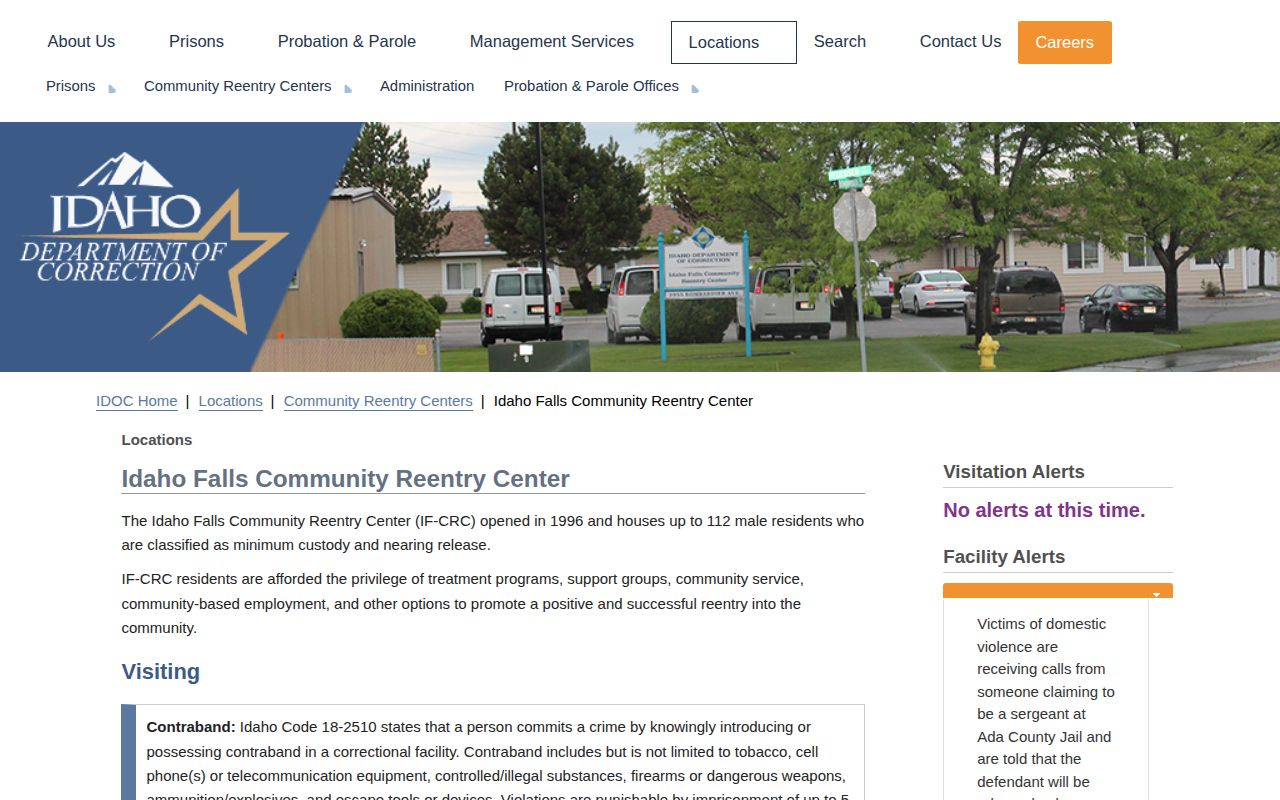
The Idaho Falls Community Reentry Center is the closest specifically documented IDOC reentry facility in this research. It houses up to 112 minimum-custody men nearing release. Despite its community setting and name, residence there is still state custody.
The official Idaho Falls center page identifies its correctional role.
Look for a later “In community” result, Released to Supervision date, sentence satisfaction, or discharge record before stating that IDOC custody ended.
Note: A move from an institution to the reentry center is a placement change, not final release from IDOC.
IDOC Jefferson County Transfers
When Jefferson County Jail transfers a person to IDOC, two records are required for a full timeline. The Sheriff record supplies the county exit date, transfer disposition, and receiving agency. IDOC supplies the state admission, custody location or community status, sentence dates, and supervision details. Neither record should be forced to answer the other's part.
A later release from IDOC can mean parole, probation placement, or another community status before full sentence satisfaction. The state record does not prove the exact county jail door-release time. If the Jefferson County transfer is disputed, request the county transport or receiving-agency record and the IDOC admission or release paper.
This distinction also protects against a common mistake: a name vanishing from county custody may signal entry into a longer state term. Only the next system establishes what happened after the local booking closed.
IDOC Holds and Later Custody
Leaving IDOC does not always end all custody. Another jurisdiction can have a warrant, detainer, or transfer request. The state release document and receiving-agency entry should show whether the person entered the community or moved directly to another authority.
An ICE detainer is one possible conditional path. ICE describes it as a request for up to 48 extra hours so immigration custody can begin. No current Jefferson County ICE contract was verified, and the possibility should not be presented as routine. If immigration custody is documented, keep the IDOC endpoint and later ICE release as separate events.
Federal custody also uses a different locator. BOP results can establish release from federal custody for people in its 1982-present data, but they cannot rewrite an earlier IDOC or Jefferson County custody event.